


Inside the IB Early Years Classroom
Key Takeaways
- The IB Early Years Programme uses inquiry-based, play-based learning instead of rote memorization.
- Student agency empowers young learners to take ownership of their learning through curiosity and exploration.
- The IB Primary Years Programme (PYP) integrates subjects through transdisciplinary learning, helping children make meaningful real-world connections.
- Research shows that the first six years of life are critical for developing executive function, cognitive flexibility, and lifelong learning skills.
Walk into a traditional early childhood classroom, and the scene is highly predictable: children sitting at desks, tracing dotted lines to master the letter "A," or chanting numbers from a blackboard. It looks like learning, but cognitively, it is mostly just compliance.
Now, walk into an International Baccalaureate (IB) Primary Years Programme (PYP) early years classroom for 3- to 6-year-olds.
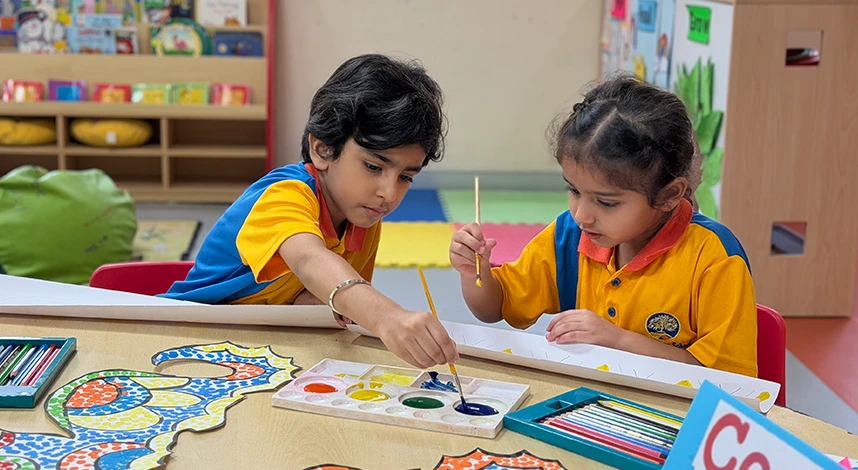
There are no flashcards, no repetitive worksheets, and no silent rows. At one table, children pour water through tubes, debating flow speeds. In a corner, another child maps a fictional town to help a toy bear find its home. This is a distinct buzz of purposeful chaos—an environment engineered specifically for how the human brain naturally learns during its most critical developmental window.
Why the First 2,000 Days Matter Most
Between birth and age six, a child’s brain forms over one million new neural connections every single second. According to extensive neuroscientific research compiled by the Harvard University Center on the Developing Child, this formative window shapes the actual architecture of the brain.
While basic reading and counting matter, the real goal of early education is to build Executive Function—the brain's air-traffic control skills:
- Working memory to retain information
- Mental flexibility to adapt to changing rules
- Cognitive self-regulation to manage emotions and focus
Traditional preschools often miss this window by focusing entirely on low-level memorization. The IB framework leverages this rapid development by shifting the focus from teaching to inquiry-based learning, helping children develop the critical thinking and problem-solving skills needed for future success.
How the IB Rewrites the Early Years Script
Instead of forcing 4-year-olds to adapt to an artificial school environment, the IB molds the environment to the child through three intentional shifts:
From Passive Tracing to Purposeful Play: Play is treated as serious academic work. Instead of worksheets, teachers design "provocations." For example, children experimenting with blocks, mirrors, and flashlights naturally discover reflection, angles, and symmetry. Because the concept is physically experienced first, the knowledge sticks. This play-based learning approach supports cognitive development, creativity, and deeper conceptual understanding.
Honoring Agency from Age Three: Student agency gives children a voice, choice, and ownership over their learning. If a child is fascinated by bugs, the bug becomes the math lesson—counting legs, comparing sizes, and charting habitats. This teaches them that their curiosity has value, making them active drivers of their education. By encouraging curiosity-driven learning, the IB helps children become confident, independent learners from an early age.
Erasing the Subject Silos: Young children do not see the world in isolated subject blocks like math at 9:00 AM and science at 10:00 AM. As outlined in the IB Primary Years Programme (PYP) Framework, learning is organized around massive, interconnected themes. A single unit on Who We Are blends emotional development, biology, language, and math. This teaches the brain to see patterns and make connections—the exact skill needed for high-level problem-solving later in life. This transdisciplinary approach reflects how children naturally learn and supports holistic child development. These lifelong learning skills are among the defining characteristics of an IB education and prepare children for future academic and personal success.
The Long-Term Return on an IB Start
Children who begin their journey in an IB Early Years setting don't just enter primary school knowing their letters and numbers; they enter knowing how to learn. They know how to ask thoughtful questions, find information, cooperate with peers, and try a different approach when a first attempt fails.
By refusing to treat early childhood as a race to memorize facts, the IB protects the natural curiosity every child is born with. It builds a child who is articulate, socially confident, emotionally resilient, and deeply in love with the process of discovery. When you build the foundation out of curiosity, the rest of the academic structure stands solid for life.
Frequently Asked Questions
What is the IB Early Years Programme?
The IB Early Years Programme is the early childhood stage of the International Baccalaureate Primary Years Programme (PYP), designed for children aged 3–6. It emphasizes inquiry-based, play-based learning, student agency, and holistic development rather than rote memorization.
What age is the IB Early Years Programme for?
The IB Early Years Programme is designed for children between the ages of 3 and 6 years, providing a strong foundation for lifelong learning before primary school.
How is an IB Early Years classroom different from a traditional preschool?
Unlike traditional preschools that often focus on worksheets and memorization, IB classrooms encourage exploration, questioning, collaboration, and real-world connections through play-based inquiry and transdisciplinary learning.
What skills do children develop in an IB Early Years classroom?
Children develop executive function, communication, collaboration, creativity, critical thinking, emotional regulation, confidence, and independence while building strong academic foundations.
References & Further Reading
- Brain Development & Executive Function: Harvard University Center on the Developing Child
- The PYP Early Years Framework: International Baccalaureate Official Guide
- The Power of Play-Based Inquiry: IBO Research on Early Childhood Learning