

Kindergarten



*As per RTE- Right to Education and NEP- National Education Policy from state to state.
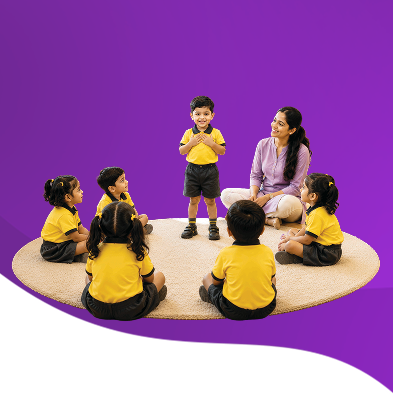
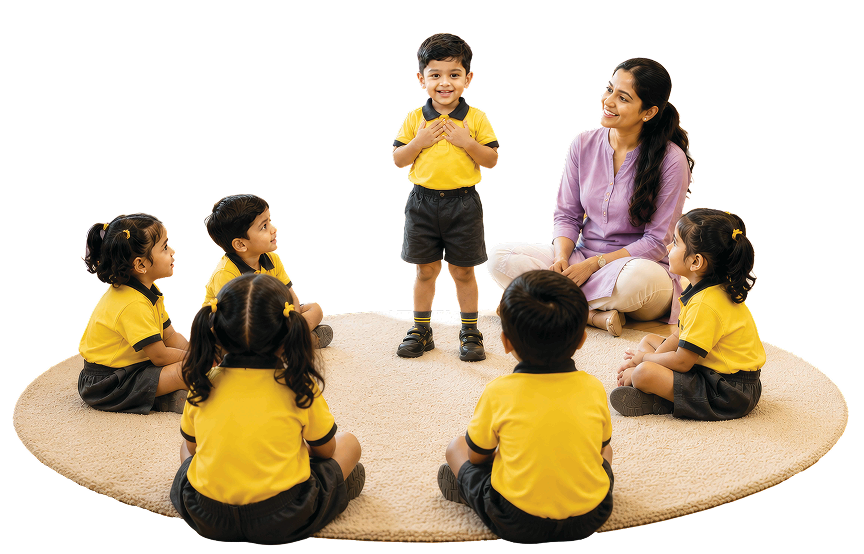
This is in progression to the Kidzee Nursery Curriculum. At Kidzee, the Kindergarten (KG) curriculum ensures a smooth transition to formal schooling. Age-appropriate activities in various areas like language, numneracy, concept, music, and art are conducted in a planned manner throughout the program. Proprietary programs for Phonics and English Readiness makes us one of the best preschools in India.
Key Areas in Playgroup Curriculum
- English Readiness Programme
- Math Operations
- Visual & Performance Art
- 'Panchkosha' integrated
- Developing oral and written communication skills
- Personal, Social, and Emotional Growth
- Promoting cognitive development (Sorts using multiple attributes)
Kidzee Sessions
- Circle Time
- Free Play
- Knowledge Time
- Language Time
- Numeracy Time
- Talk Time
- Outdoor
- Indoor
- Field Trips
- Puppet shows and skits
- Phonics
- Hindi*
- Celebration of festivals and special days
Kidzee Special
- English Readiness Programme
- Artsy
- Personality Development
- Showstopper
- Mental Might
- Eco-conscious
- Tell-a-Tale
- Library
- Sciencify
- Whirl & Twirl
- Sensorium
- Critical Thinking - Problem solving
- Intergrated Sanskar
- Augmented Reality - Fantasy Box

FAQs
What is the right age for kindergarten (KG) admission in India?
The right age for kindergarten admission in India is generally 4 to 5 years, with children usually joining Junior Kindergarten (Jr. KG) at around 4 years and Senior Kindergarten (Sr. KG) at around 5 years. The exact age criteria may vary by state and school.
At Kidzee, the broad recommended age groups are 4–5 years for Junior KG and 5–6 years for Senior KG. These programmes help children build early language, numeracy, social and thinking skills before entering primary school. Contact your nearest Kidzee centre to confirm the applicable age criteria for your child.
What is the age criteria for Junior KG admission?
The usual age for Junior KG admission in India is around 4 years, with children generally falling in the 4–5-year age group. However, the minimum age and cut-off date depend on the applicable state guidelines and school admission policy.
Parents should check the current age eligibility and admission cut-off date with their nearest centre before applying.
What is the age criteria for Senior KG admission?
The usual age for Senior KG admission in India is around 5 years, with children generally falling in the 5–6-year age group. The exact eligibility criteria may vary depending on state regulations and the school's admission policy.
Contact your nearest Kidzee centre to confirm the required age, admission dates and eligibility criteria for the academic year.
What documents are required for kindergarten admission?
For kindergarten admission, parents are commonly asked to provide the child's birth certificate and recent passport-sized photographs. Schools may also request identification or address proof and previous school records, depending on the child's admission level and the centre's requirements.
Commonly requested documents include:
- Birth certificate: To verify the child's age.
- Passport-sized photographs: Recent photographs of the child.
- Parent or guardian details: Contact information and identification, if required.
- Address proof: If requested by the centre.
- Previous school records: A report card or transfer certificate, if applicable, particularly for children moving from another school.
For Jr. KG or Sr. KG admission at Kidzee, contact your nearest centre for the latest document checklist before completing the admission process.
How do I apply for kindergarten admission at Kidzee?
To apply for kindergarten admission at Kidzee, fill out the admission enquiry form on the official website. The team will connect with you to guide you through the admission process and help you identify a suitable centre.
Follow these steps:
- Visit the Kidzee admission enquiry page.
- Submit the enquiry form with your contact details and your child's information.
- Connect with the nearest Kidzee centre to discuss age eligibility, timings and availability.
- Visit the centre to explore its learning environment and understand the programme.
- Submit the required documents and complete the admission formalities.
Contact your preferred Kidzee centre to confirm current admission dates, fees and seat availability for Junior KG or Senior KG.
How does kindergarten prepare children for primary school?
Kindergarten prepares children for Primary School by building a strong foundation in academic, social, emotional and practical skills. Through engaging, play-based and structured learning experiences, children gradually develop the confidence and independence needed for a smooth transition to formal schooling.
Children develop readiness through:
- Literacy & Language: Developing reading, writing, listening, speaking and comprehension skills.
- Numeracy: Understanding numbers, basic mathematical operations, patterns, shapes and problem-solving.
- Cognitive Development: Strengthening observation, logical thinking, reasoning, memory and inquiry.
- Social & Emotional Skills: Building confidence, empathy, cooperation, self-regulation and positive relationships.
- Physical Development: Refining fine motor skills, pencil control, coordination and physical fitness.
- Communication & Expression: Learning to share ideas, ask questions, express opinions and participate in group discussions.
- Independence & Responsibility: Managing personal belongings, following routines, completing tasks and making simple decisions.
- Learning Behaviours: Developing curiosity, concentration, perseverance and a positive attitude towards learning.
Most importantly, Kindergarten nurtures confident, curious and independent learners who are ready to embrace new challenges, build relationships and enjoy their journey into Primary School.
What are the kindergarten fees at Kidzee?
Kindergarten fees at Kidzee vary by centre and location. The total cost depends on the centre's fee structure, facilities and the services included in the programme.
Before enrolling your child, ask the centre for a detailed breakdown of:
- Registration and admission fees.
- Tuition fees and payment schedules.
- Books, learning materials and activity charges.
- Uniforms, transport or meals, if applicable.
- Any additional charges.
For accurate and up-to-date Kidzee kindergarten fees, contact your nearest centre directly. The team can explain the applicable charges, payment terms and available admission options.
What is the duration of the Kindergarten programme?
A kindergarten child at Kidzee typically attends school for 4 hours a day, depending on the centre and its schedule.
The daily routine may include circle time, language activities, numeracy, stories, creative activities, music and movement, and indoor or outdoor play. These sessions give children a balance of guided learning and opportunities to explore and interact.
Contact your nearest Kidzee centre to confirm the current Junior KG and Senior KG timings, including any differences between batches or locations.
How can I find a kindergarten school near me?
You can find a Kidzee kindergarten school near you by visiting the official Kidzee admission website and submitting an enquiry. The team can help connect you with a nearby centre and explain the available programmes.
Here is how to get started:
- Visit the Kidzee admission enquiry page.
- Submit your contact details and your child's information.
- Connect with the nearest Kidzee centre.
- Confirm the availability of Junior KG or Senior KG, age eligibility, fees and timings.
- Arrange a visit to explore the centre before making your decision.
You can also search Google for “kindergarten school near me”, “LKG admission near me” or “UKG admission near me” to discover nearby options. Contact the centre to verify the latest admission details.
Does kindergarten include play-based learning?
Yes, kindergarten includes play-based learning, which helps children understand concepts through activities, exploration and interaction. Play can make early learning more engaging while supporting language, numeracy, creativity and social development.
Play-based kindergarten activities may include:
- Counting games and number puzzles.
- Stories, rhymes and phonics activities.
- Drawing, painting and creative projects.
- Building blocks, sorting games and shape recognition.
- Music, movement and role-play.
- Group activities that encourage sharing and teamwork.
At Kidzee, the kindergarten curriculum combines structured learning with age-appropriate activities, helping children build foundational skills while enjoying the learning process.
How do I choose the best kindergarten school for my child?
To choose the best kindergarten school for your child, look for a safe, welcoming environment with caring teachers, a suitable curriculum and activities that support overall development. The school should help your child learn at an age-appropriate pace while building confidence and independence.
Consider these factors before making a decision:
- Safety and hygiene: Check the centre's cleanliness, safety measures and entry and exit procedures.
- Teachers and caregivers: Look for teachers who understand young children's needs and provide patient guidance.
- Curriculum: Check for a balance of language, maths, creative activities, physical development and social learning.
- Learning environment: Look for child-friendly classrooms, suitable learning materials and opportunities for hands-on exploration.
- Individual attention: Ask about class size and how teachers support children with different learning needs.
- School readiness: Understand how the programme builds foundational skills for Class 1.
- Parent communication: Ask how the school shares updates about your child's learning and progress.
- Location and timings: Consider travel time and the daily schedule.
- Fees and facilities: Review the full fee structure and any additional costs.
If you are considering Kidzee, visit your nearest centre to explore its kindergarten programme, speak with the team and understand how the learning environment can support your child's next stage of development.
What is Kidzee kindergarten admission procedure?
Are there field trips for kindergarten students?
What are the safety and security measures in Kidzee Kindergarten?
What is the right age for kindergarten (KG) admission in India?
The right age for kindergarten admission in India is generally 4 to 5 years, with children usually joining Junior Kindergarten (Jr. KG) at around 4 years and Senior Kindergarten (Sr. KG) at around 5 years. The exact age criteria may vary by state and school.
At Kidzee, the broad recommended age groups are 4–5 years for Junior KG and 5–6 years for Senior KG. These programmes help children build early language, numeracy, social and thinking skills before entering primary school. Contact your nearest Kidzee centre to confirm the applicable age criteria for your child.
The usual age for Junior KG admission in India is around 4 years, with children generally falling in the 4–5-year age group. However, the minimum age and cut-off date depend on the applicable state guidelines and school admission policy.
Parents should check the current age eligibility and admission cut-off date with their nearest centre before applying.
What is the age criteria for Senior KG admission?
The usual age for Senior KG admission in India is around 5 years, with children generally falling in the 5–6-year age group. The exact eligibility criteria may vary depending on state regulations and the school's admission policy.
Contact your nearest Kidzee centre to confirm the required age, admission dates and eligibility criteria for the academic year.
For kindergarten admission, parents are commonly asked to provide the child's birth certificate and recent passport-sized photographs. Schools may also request identification or address proof and previous school records, depending on the child's admission level and the centre's requirements.
Commonly requested documents include:
- Birth certificate: To verify the child's age.
- Passport-sized photographs: Recent photographs of the child.
- Parent or guardian details: Contact information and identification, if required.
- Address proof: If requested by the centre.
- Previous school records: A report card or transfer certificate, if applicable, particularly for children moving from another school.
For Jr. KG or Sr. KG admission at Kidzee, contact your nearest centre for the latest document checklist before completing the admission process.
How do I apply for kindergarten admission at Kidzee?
To apply for kindergarten admission at Kidzee, fill out the admission enquiry form on the official website. The team will connect with you to guide you through the admission process and help you identify a suitable centre.
Follow these steps:
- Visit the Kidzee admission enquiry page.
- Submit the enquiry form with your contact details and your child's information.
- Connect with the nearest Kidzee centre to discuss age eligibility, timings and availability.
- Visit the centre to explore its learning environment and understand the programme.
- Submit the required documents and complete the admission formalities.
Contact your preferred Kidzee centre to confirm current admission dates, fees and seat availability for Junior KG or Senior KG.
Kindergarten prepares children for Primary School by building a strong foundation in academic, social, emotional and practical skills. Through engaging, play-based and structured learning experiences, children gradually develop the confidence and independence needed for a smooth transition to formal schooling.
Children develop readiness through:
- Literacy & Language: Developing reading, writing, listening, speaking and comprehension skills.
- Numeracy: Understanding numbers, basic mathematical operations, patterns, shapes and problem-solving.
- Cognitive Development: Strengthening observation, logical thinking, reasoning, memory and inquiry.
- Social & Emotional Skills: Building confidence, empathy, cooperation, self-regulation and positive relationships.
- Physical Development: Refining fine motor skills, pencil control, coordination and physical fitness.
- Communication & Expression: Learning to share ideas, ask questions, express opinions and participate in group discussions.
- Independence & Responsibility: Managing personal belongings, following routines, completing tasks and making simple decisions.
- Learning Behaviours: Developing curiosity, concentration, perseverance and a positive attitude towards learning.
Most importantly, Kindergarten nurtures confident, curious and independent learners who are ready to embrace new challenges, build relationships and enjoy their journey into Primary School.
What are the kindergarten fees at Kidzee?
Kindergarten fees at Kidzee vary by centre and location. The total cost depends on the centre's fee structure, facilities and the services included in the programme.
Before enrolling your child, ask the centre for a detailed breakdown of:
- Registration and admission fees.
- Tuition fees and payment schedules.
- Books, learning materials and activity charges.
- Uniforms, transport or meals, if applicable.
- Any additional charges.
For accurate and up-to-date Kidzee kindergarten fees, contact your nearest centre directly. The team can explain the applicable charges, payment terms and available admission options.
A kindergarten child at Kidzee typically attends school for 4 hours a day, depending on the centre and its schedule.
The daily routine may include circle time, language activities, numeracy, stories, creative activities, music and movement, and indoor or outdoor play. These sessions give children a balance of guided learning and opportunities to explore and interact.
Contact your nearest Kidzee centre to confirm the current Junior KG and Senior KG timings, including any differences between batches or locations.
How can I find a kindergarten school near me?
You can find a Kidzee kindergarten school near you by visiting the official Kidzee admission website and submitting an enquiry. The team can help connect you with a nearby centre and explain the available programmes.
Here is how to get started:
- Visit the Kidzee admission enquiry page.
- Submit your contact details and your child's information.
- Connect with the nearest Kidzee centre.
- Confirm the availability of Junior KG or Senior KG, age eligibility, fees and timings.
- Arrange a visit to explore the centre before making your decision.
You can also search Google for “kindergarten school near me”, “LKG admission near me” or “UKG admission near me” to discover nearby options. Contact the centre to verify the latest admission details.
Yes, kindergarten includes play-based learning, which helps children understand concepts through activities, exploration and interaction. Play can make early learning more engaging while supporting language, numeracy, creativity and social development.
Play-based kindergarten activities may include:
- Counting games and number puzzles.
- Stories, rhymes and phonics activities.
- Drawing, painting and creative projects.
- Building blocks, sorting games and shape recognition.
- Music, movement and role-play.
- Group activities that encourage sharing and teamwork.
At Kidzee, the kindergarten curriculum combines structured learning with age-appropriate activities, helping children build foundational skills while enjoying the learning process.
How do I choose the best kindergarten school for my child?
To choose the best kindergarten school for your child, look for a safe, welcoming environment with caring teachers, a suitable curriculum and activities that support overall development. The school should help your child learn at an age-appropriate pace while building confidence and independence.
Consider these factors before making a decision:
- Safety and hygiene: Check the centre's cleanliness, safety measures and entry and exit procedures.
- Teachers and caregivers: Look for teachers who understand young children's needs and provide patient guidance.
- Curriculum: Check for a balance of language, maths, creative activities, physical development and social learning.
- Learning environment: Look for child-friendly classrooms, suitable learning materials and opportunities for hands-on exploration.
- Individual attention: Ask about class size and how teachers support children with different learning needs.
- School readiness: Understand how the programme builds foundational skills for Class 1.
- Parent communication: Ask how the school shares updates about your child's learning and progress.
- Location and timings: Consider travel time and the daily schedule.
- Fees and facilities: Review the full fee structure and any additional costs.
If you are considering Kidzee, visit your nearest centre to explore its kindergarten programme, speak with the team and understand how the learning environment can support your child's next stage of development.
Are there field trips for kindergarten students?
The right age for kindergarten admission in India is generally 4 to 5 years, with children usually joining Junior Kindergarten (Jr. KG) at around 4 years and Senior Kindergarten (Sr. KG) at around 5 years. The exact age criteria may vary by state and school.
At Kidzee, the broad recommended age groups are 4–5 years for Junior KG and 5–6 years for Senior KG. These programmes help children build early language, numeracy, social and thinking skills before entering primary school. Contact your nearest Kidzee centre to confirm the applicable age criteria for your child.
What is the age criteria for Junior KG admission?
The usual age for Junior KG admission in India is around 4 years, with children generally falling in the 4–5-year age group. However, the minimum age and cut-off date depend on the applicable state guidelines and school admission policy.
Parents should check the current age eligibility and admission cut-off date with their nearest centre before applying.
The usual age for Senior KG admission in India is around 5 years, with children generally falling in the 5–6-year age group. The exact eligibility criteria may vary depending on state regulations and the school's admission policy.
Contact your nearest Kidzee centre to confirm the required age, admission dates and eligibility criteria for the academic year.
What documents are required for kindergarten admission?
For kindergarten admission, parents are commonly asked to provide the child's birth certificate and recent passport-sized photographs. Schools may also request identification or address proof and previous school records, depending on the child's admission level and the centre's requirements.
Commonly requested documents include:
- Birth certificate: To verify the child's age.
- Passport-sized photographs: Recent photographs of the child.
- Parent or guardian details: Contact information and identification, if required.
- Address proof: If requested by the centre.
- Previous school records: A report card or transfer certificate, if applicable, particularly for children moving from another school.
For Jr. KG or Sr. KG admission at Kidzee, contact your nearest centre for the latest document checklist before completing the admission process.
To apply for kindergarten admission at Kidzee, fill out the admission enquiry form on the official website. The team will connect with you to guide you through the admission process and help you identify a suitable centre.
Follow these steps:
- Visit the Kidzee admission enquiry page.
- Submit the enquiry form with your contact details and your child's information.
- Connect with the nearest Kidzee centre to discuss age eligibility, timings and availability.
- Visit the centre to explore its learning environment and understand the programme.
- Submit the required documents and complete the admission formalities.
Contact your preferred Kidzee centre to confirm current admission dates, fees and seat availability for Junior KG or Senior KG.
How does kindergarten prepare children for primary school?
Kindergarten prepares children for Primary School by building a strong foundation in academic, social, emotional and practical skills. Through engaging, play-based and structured learning experiences, children gradually develop the confidence and independence needed for a smooth transition to formal schooling.
Children develop readiness through:
- Literacy & Language: Developing reading, writing, listening, speaking and comprehension skills.
- Numeracy: Understanding numbers, basic mathematical operations, patterns, shapes and problem-solving.
- Cognitive Development: Strengthening observation, logical thinking, reasoning, memory and inquiry.
- Social & Emotional Skills: Building confidence, empathy, cooperation, self-regulation and positive relationships.
- Physical Development: Refining fine motor skills, pencil control, coordination and physical fitness.
- Communication & Expression: Learning to share ideas, ask questions, express opinions and participate in group discussions.
- Independence & Responsibility: Managing personal belongings, following routines, completing tasks and making simple decisions.
- Learning Behaviours: Developing curiosity, concentration, perseverance and a positive attitude towards learning.
Most importantly, Kindergarten nurtures confident, curious and independent learners who are ready to embrace new challenges, build relationships and enjoy their journey into Primary School.
Kindergarten fees at Kidzee vary by centre and location. The total cost depends on the centre's fee structure, facilities and the services included in the programme.
Before enrolling your child, ask the centre for a detailed breakdown of:
- Registration and admission fees.
- Tuition fees and payment schedules.
- Books, learning materials and activity charges.
- Uniforms, transport or meals, if applicable.
- Any additional charges.
For accurate and up-to-date Kidzee kindergarten fees, contact your nearest centre directly. The team can explain the applicable charges, payment terms and available admission options.
What is the duration of the Kindergarten programme?
A kindergarten child at Kidzee typically attends school for 4 hours a day, depending on the centre and its schedule.
The daily routine may include circle time, language activities, numeracy, stories, creative activities, music and movement, and indoor or outdoor play. These sessions give children a balance of guided learning and opportunities to explore and interact.
Contact your nearest Kidzee centre to confirm the current Junior KG and Senior KG timings, including any differences between batches or locations.
You can find a Kidzee kindergarten school near you by visiting the official Kidzee admission website and submitting an enquiry. The team can help connect you with a nearby centre and explain the available programmes.
Here is how to get started:
- Visit the Kidzee admission enquiry page.
- Submit your contact details and your child's information.
- Connect with the nearest Kidzee centre.
- Confirm the availability of Junior KG or Senior KG, age eligibility, fees and timings.
- Arrange a visit to explore the centre before making your decision.
You can also search Google for “kindergarten school near me”, “LKG admission near me” or “UKG admission near me” to discover nearby options. Contact the centre to verify the latest admission details.
Does kindergarten include play-based learning?
Yes, kindergarten includes play-based learning, which helps children understand concepts through activities, exploration and interaction. Play can make early learning more engaging while supporting language, numeracy, creativity and social development.
Play-based kindergarten activities may include:
- Counting games and number puzzles.
- Stories, rhymes and phonics activities.
- Drawing, painting and creative projects.
- Building blocks, sorting games and shape recognition.
- Music, movement and role-play.
- Group activities that encourage sharing and teamwork.
At Kidzee, the kindergarten curriculum combines structured learning with age-appropriate activities, helping children build foundational skills while enjoying the learning process.
To choose the best kindergarten school for your child, look for a safe, welcoming environment with caring teachers, a suitable curriculum and activities that support overall development. The school should help your child learn at an age-appropriate pace while building confidence and independence.
Consider these factors before making a decision:
- Safety and hygiene: Check the centre's cleanliness, safety measures and entry and exit procedures.
- Teachers and caregivers: Look for teachers who understand young children's needs and provide patient guidance.
- Curriculum: Check for a balance of language, maths, creative activities, physical development and social learning.
- Learning environment: Look for child-friendly classrooms, suitable learning materials and opportunities for hands-on exploration.
- Individual attention: Ask about class size and how teachers support children with different learning needs.
- School readiness: Understand how the programme builds foundational skills for Class 1.
- Parent communication: Ask how the school shares updates about your child's learning and progress.
- Location and timings: Consider travel time and the daily schedule.
- Fees and facilities: Review the full fee structure and any additional costs.
If you are considering Kidzee, visit your nearest centre to explore its kindergarten programme, speak with the team and understand how the learning environment can support your child's next stage of development.
What is Kidzee kindergarten admission procedure?
What are the safety and security measures in Kidzee Kindergarten?
Blogs
n the bustling routine of school days, crafting a lunchbox that is both enticing and nutritious can be a formidable challenge for parents. With busy schedules, looming deadlines, and the constant juggle of responsibilities, finding the perfect balance between a meal that excites young palates and one that nourishes their growing bodies becomes a daily feat.

In a world where screens and technology often consume our children's attention, the timeless allure of indoor games for kids remains a cherished tradition. These indoor activities for kids not only provide hours of entertainment but also offer a myriad of developmental benefits. As parents and caregivers, we understand the importance of nurturing our children's creativity, physical health, and cognitive skills. Indoor games, with their versatility and accessibility, emerge as an ideal solution.
n the bustling routine of school days, crafting a lunchbox that is both enticing and nutritious can be a formidable challenge for parents. With busy schedules, looming deadlines, and the constant juggle of responsibilities, finding the perfect balance between a meal that excites young palates and one that nourishes their growing bodies becomes a daily feat.
In a world where screens and technology often consume our children's attention, the timeless allure of indoor games for kids remains a cherished tradition. These indoor activities for kids not only provide hours of entertainment but also offer a myriad of developmental benefits. As parents and caregivers, we understand the importance of nurturing our children's creativity, physical health, and cognitive skills. Indoor games, with their versatility and accessibility, emerge as an ideal solution.